Iran submits two proposals to ISO for nanotechnology standards
TEHRAN – Iran has put forward two proposals to the International Organization for Standardization (ISO) aimed at developing international standards in the field of nanotechnology.
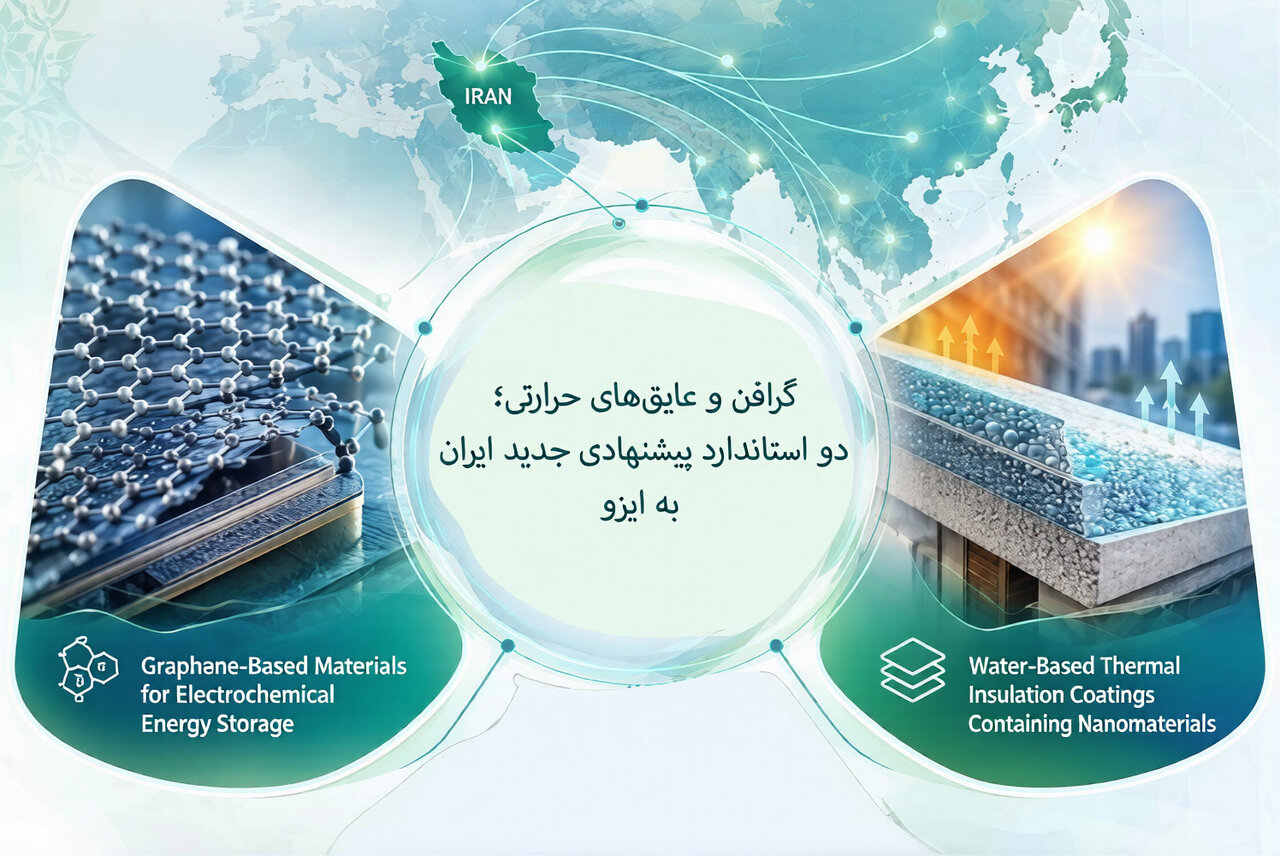
The first proposal focuses on establishing standards for silica aerogel-based thermal insulation coatings containing nanomaterials, with an emphasis on defining their properties as well as methods for measurement and performance evaluation.
Owing to their nanoporous structure and excellent thermal insulation properties, silica aerogels have attracted considerable attention as promising materials for advanced thermal insulation coatings. The establishment of an international standard could provide a clear and consistent framework for assessing and comparing the performance of such products.
The second suggestion concentrates on graphene-based materials for electrochemical energy storage. The standard will provide a basis for evaluating and comparing the performance of graphene-based materials in energy storage systems, a field which has gained increasing importance with the development of advanced battery and supercapacitor technologies.
The proposals will be discussed at the ISO/TC 229 Technical Committee meeting on Nanotechnology, which is scheduled to be held in Mexico from October 19 to 23, 2026. Iranian representatives will attend the meeting online.
The country has played an active role in proposing international standards; it is placed fourth following the US, South Korea, and Japan. So far, some13 international nanotechnology standards have been developed at Iran’s proposal, Mehr news agency reported.
Nanotech progress in Iran beyond just a scientific achievement
With over 430 companies operating in the nanotechnology sector, and more than 1,960 nanotech products receiving nanoscale certificates, the advancement of the nanotechnology sector in the country proves to be more than just a scientific achievement.
Relying on domestic capacity, nanotechnology in Iran is not merely measured by scientific rankings and published articles, but products that have been manufactured and entered the industry and the market, IRNA reported.
The total sale of these products amounts to over 970 trillion rials (about 554 million dollars), indicating that the scientific achievement has become an economic and industrial capacity.
Nanotechnology in the country is a typical example of a successful development of a tech ecosystem. From the very beginning, a long-term roadmap was developed to strengthen all aspects of the technology development chain, from education and research to commercialization and market development.
Over the past years, the role of Nano headquarters has not been limited to macro-policy-making, but has included fostering coordination among universities, research institutes, industries, knowledge-based companies, and supporting institutions.
Establishing a strategic technological laboratory network, developing standards for the evaluation of Nano products, supporting start-up companies, and designing industrial programs are among the factors that help transfer nanotechnology from laboratories to the country’s industries.
Despite the 12-day war in June 2025 and the recent 40-day war, 230 products received nanoscale certificates in the past Iranian calendar year (March 2025-March 2026), surpassing the targeted number.
Last year, the Vice Presidency for Science, Technology, and Knowledge-Based Economy and the headquarters for nanotechnology planned to obtain nanoscale certificates for 190 products (one product per working day). Still, the figure increased by 40, reaching 230. Currently, the total number of nanotechnology products with a nanoscale certificate has increased to 1965, IRNA reported.
The highest number of products that received nanoscale certificates was recorded respectively in the provinces of Tehran, Fars, and Mazandaran, with 64, 48, and 24 products, respectively.
The provinces of Zanjan (32 products), Qom (17), Markazi (16), Qazvin (11), and Isfahan (7) are placed next.
Out of 230 products, Industrial supplies had the largest share with 72 products. Energy, oil, and related industries accounted for 41, Chemicals for 36, and Pharmaceutical and Health for 26 products.
MT/MG
Leave a Comment